
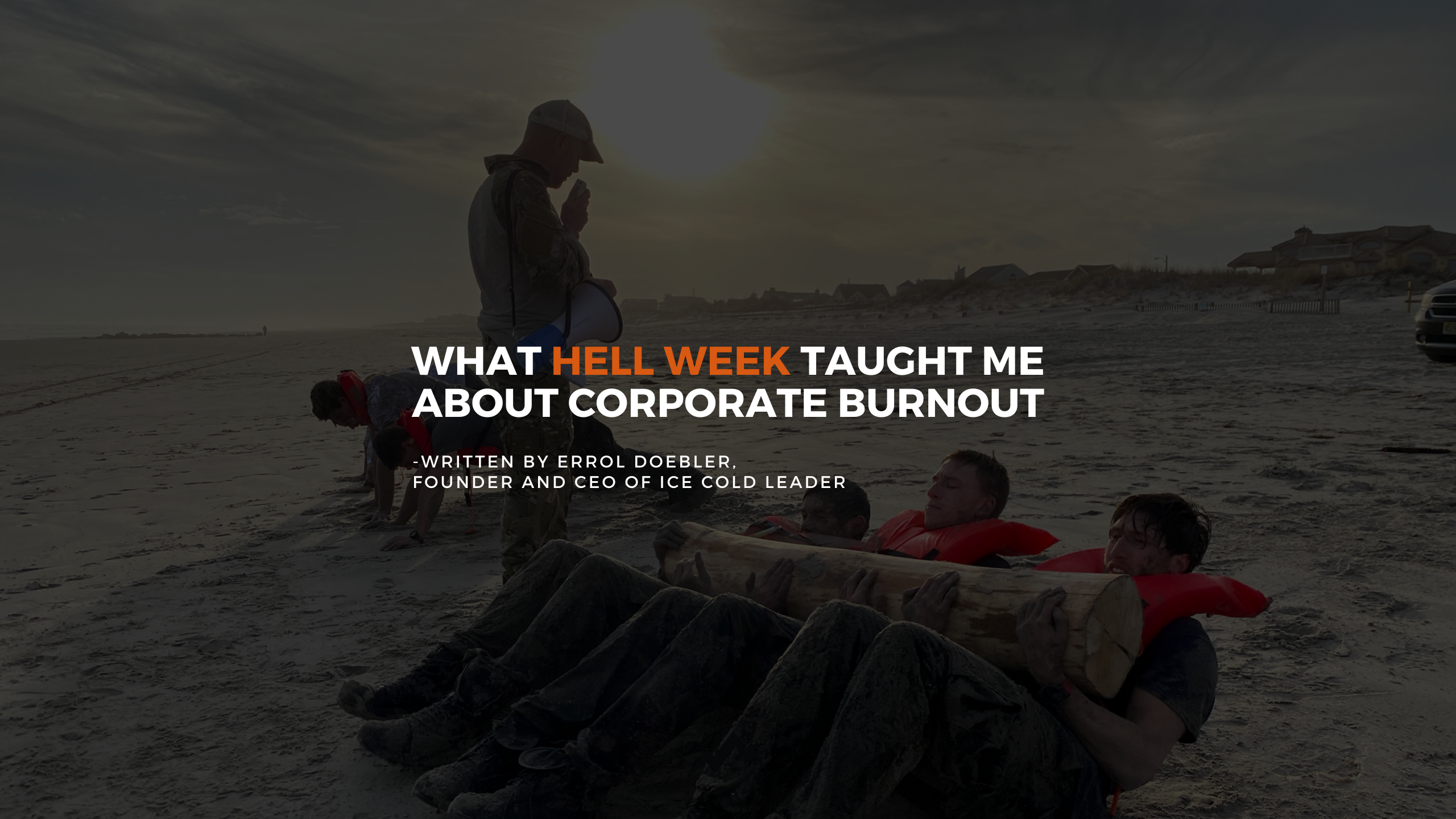
What Hell Week taught me about corporate burnout.

In the SEAL Teams, sleep deprivation isn’t a “side effect.” It’s a weapon. And it taught me more about corporate burnout than any boardroom ever did.
During Hell Week, you’re kept awake and under constant physical, mental, and emotional stress for days. The point isn’t to see who can suffer the most.
The point is to see:
- Who can still think clearly when everything in them wants to shut down
- Who can still make good decisions when they’re exhausted, cold, and overwhelmed
- Who actually knows their limits—and respects them
That’s what most corporate leaders are getting wrong.
They’re running real-life Hell Weeks inside their companies…with no defined end, no recovery phase, and no mission important enough to justify the cost.
Burnout isn’t a badge of honor. It’s evidence that leadership has stopped doing its job.
What Hell Week is really testing
People love to talk about Hell Week like it’s some epic test of physical toughness.
It’s not.
Yes, you’re cold, wet, hungry, and exhausted. Yes, you’re doing log PT, boat carries, timed runs, surf torture, and everything else the instructors dream up.
But here’s the truth:
You can still move. You can still run. You can still carry the boat.
What breaks down is:
- Your ability to make sound decisions
- Your ability to regulate emotion
- Your ability to prioritize under pressure
By around 48 hours of true sleep deprivation, things get interesting. You can still operate, but your judgment is compromised. You hesitate. You miss things. You start making worse calls.
The instructors know this. They’re not just watching whether you can “gut it out.”
They’re watching how you operate when you are right on the edge of losing yourself.
The lesson I took with me: know exactly where you lose capacity
Hell Week didn’t just give me a war story. It gave me a map.
I came out of it with a very specific understanding:
- Where my best capacity starts to drop
- What “too far” looks and feels like mentally and emotionally
- When I need to stop or reset so the mission doesn’t suffer
That changed the way I operated from then on.
On a 10-mile movement, for example, we didn’t just “grind” and call it toughness. We built in smart, early resets—not because we were soft, but because we knew:
If we don’t manage mental and emotional fatigue early, it will own us later.
In Hell Week, your physical capacity rarely disappears. Your mental and emotional capacity do.
That’s the piece missing in most executive playbooks.
Leaders still measure their limits by physical indicators:
- “I’m still awake, so I’m fine.”
- “I can power through one more late night.”
- “I’ll catch up this weekend.”
In the Teams, thinking like that gets people hurt. In business, it gets people burned out, reactive, and sloppy at the exact moment they need to be sharp.
Corporate burnout: Hell Week with no end date
Corporate burnout rarely comes from one insane week.
It comes from indefinite overextension:
- 70–90 hour weeks that stopped being “temporary” a long time ago
- Quarter after quarter of crisis mode
- “Always on” communication that never lets the nervous system downshift
- Leaders modeling chronic exhaustion as if it’s commitment
That’s not resilience. That’s poorly designed leadership.
In the military, we use sleep deprivation and overload for a few days to:
- Test who can be trusted with the hardest decisions
- Expose weaknesses so we can address them
- Build self-awareness of where the edge really is
Then we stop. We recover. We adjust how we train and how we operate.
Corporate life often flips that:
- No stop
- No meaningful recovery
- No honest debrief
- No structural change—just “dig deep” and do it again next quarter
That’s not toughness. That’s negligence with a nice title.
My own burnout wake-up call
I’m not writing this as a guy who’s figured it all out and risen above it.
Last fall, I ran myself into the wall.
Between running Ice Cold Leader, serving as a fractional CEO, traveling, coaching, writing, and trying to be fully present at home, I did the exact thing I warn executives about:
- Too many 14–16 hour days
- Too much travel with no deliberate recovery
- Too many “I’ll just push through this week” conversations with myself
Physically, I was fine. I could still train. I could still get on the plane. I could still show up.
Mentally and emotionally? The edge dulled.
I was shorter. Less patient. Less clear. My decision-making was not at the standard I demand of myself—or anyone I coach.
A former SEAL and FBI Special Agent—someone who teaches emotional awareness and process under pressure—had fallen into the same trap as everyone else.
That’s the point:
The issue isn’t whether you’ll push too far. At some point, you will.
The issue is: What do you do once you see it?
The real lesson: find your limits, then stop living there
Hell Week taught me something most high performers miss:
You should push your limits sometimes. You need to know where the edge actually is.
But once you know where your judgment drops, where your emotional control slips, where your leadership quality falls off?
The goal is not to camp on that edge. The goal is to design your life and your leadership so you rarely have to go there.
That’s where many executives get it backwards.
They treat every quarter like Hell Week:
- Endless sprints with no real recovery
- “All hands on deck” as the default, not the exception
- Living permanently at the threshold of collapse
If we ran special operations that way, we’d fail the mission and burn out the force.
Apply it this week: think like a special operations planner
- Know your red lines. For you and your key people, define what “too far” looks like mentally and emotionally—not just in hours.
- Build early resets into the plan. Don’t wait until everyone is fried. Put short recovery windows on the calendar before you think you “need” them.
- Use intensity as a tool, not an identity. There are moments to surge. They should be rare, deliberate, and time-bound—not your operating system.
- Debrief your own burnout. When you hit the wall, don’t shrug and move on. Ask: What pattern got me here? What has to change so this doesn’t repeat?
What this means for leaders now
If you’re heading into next year saying:
“I’ll push hard now and fix the balance later…”
Be honest—how many years have you said that?
Hell Week taught me exactly where my edge is. Corporate burnout reminded me I’m not above ignoring it.
The shift isn’t complicated. It’s just uncomfortable:
- Push your limits on purpose once in a while so you really know them.
- Then adjust your systems, schedule, and expectations so you don’t live at that edge.
- Do the same for your team. Protect long-term capacity, not just short-term output.
Your body will carry you longer than your brain can lead. Your title will take you further than your judgment should.
The leaders who win long-term aren’t the ones who suffer the most. They’re the ones who know exactly when to stop, reset, and come back sharper.
That’s not weakness. That’s discipline.
And that’s the difference between building a career—and burning one down.
Keep your eyes on the target. — Errol
This lesson is one of hundreds.
SMACCC is the planning process I ran in combat and run with CEOs today. Free and fillable, about twenty minutes.
Get the WorkbookLeading from the inside out. The full story and the complete methodology, born of blood, not a whiteboard.
Get the BookCorporate coaching, keynotes, and team experiences. The process, run with your leaders, in your building.
See CoachingOne moment in history, one leadership lesson, every week. Real events, real decisions, and the principle each one proves.
Read the SeriesBattle-tested leadership from the SEALs, the FBI, and the boardroom. No fluff. Unsubscribe anytime.


Leave a Reply